
When Grief Finds You
Losing a mother is a wound that never fully closes. For me, the loss of my mom felt like someone had pulled the ground out from under me. Our relationship was a complicated one, and knowing I would never be able to fix anything that was left said between us. Left me feeling lost, hollow, and disconnected.
Grief is complicated. Some days it’s a whisper, other days it crashes like a storm you didn’t see coming. I tried many things to cope: long walks, late-night prayers, talking to family and friends. But the thing that became my lifeline was something I had always turned to in smaller ways—writing.
Writing gave me a place to put my pain, my confusion, and even my love. It became my therapy, not in a clinical sense, but in a deeply personal one. It was where I could be raw and real without fear of judgment.
In this blog, I want to share how writing helped me through grief, what I discovered about myself in the process, and why I believe words can heal—not just for me, but for other women who have walked through the same kind of loss.
The Silence Grief Brings
When my mom passed, one of the hardest things wasn’t just her absence; it was the silence. There were no more talks no more hearing her voice, or no more “just checking in” conversations. That silence was deafening.
I quickly realized grief has its own language, but most people don’t know how to speak it. Well-meaning friends would say, “She’s in a better place,” or “At least she’s not suffering anymore.” Those words didn’t help.
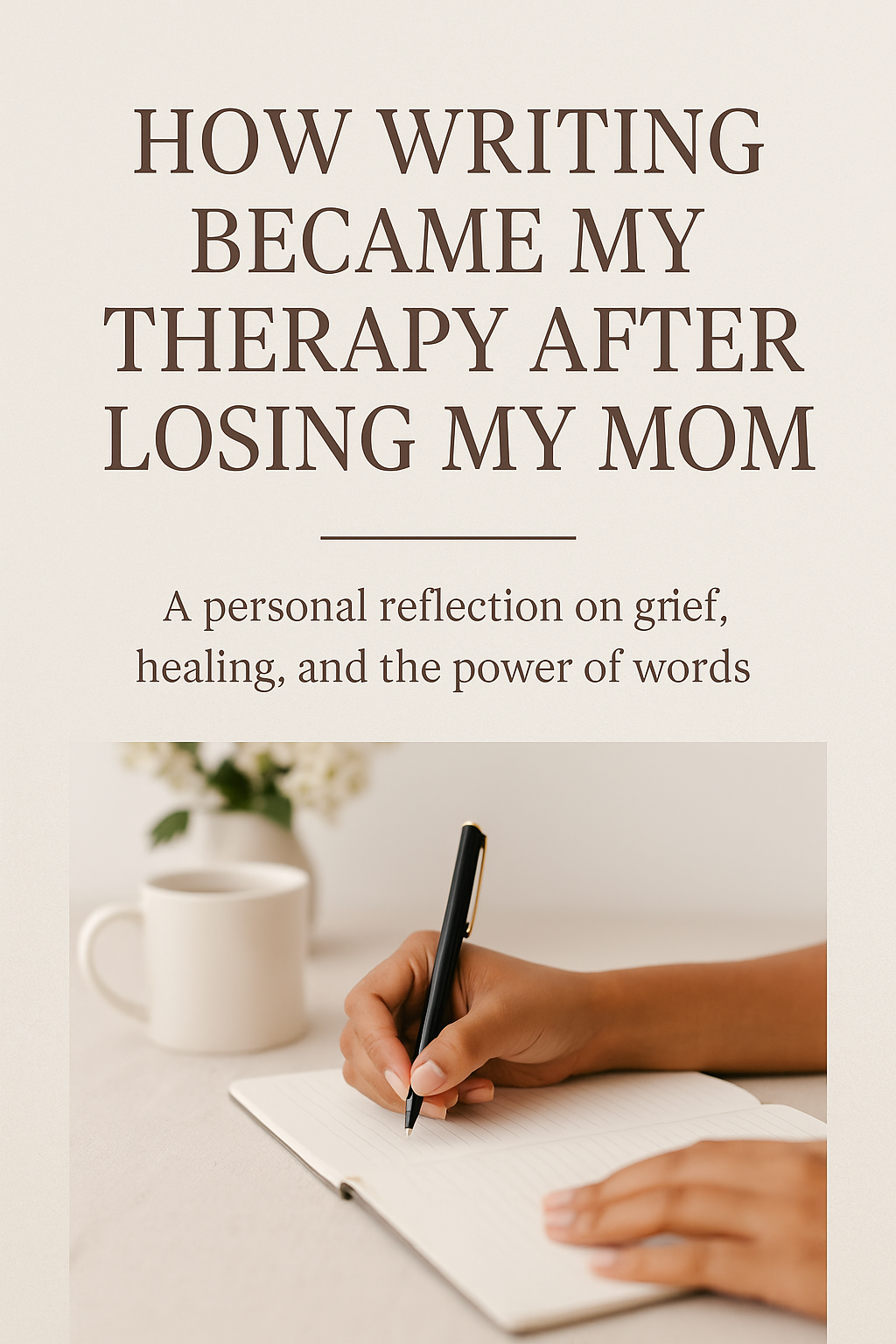
I needed a way to process what I was feeling without needing anyone else to understand it. That’s when I picked up my pen and notebook again.
Writing as a Safe Place
The first night I wrote after her passing, I didn’t even think—it just spilled out. Tears blurred the ink, but I kept going.
In my journal, I didn’t have to make sense. I didn’t have to sound strong. I didn’t have to filter my words for someone else’s comfort.
Writing gave me permission to:
• Say the things I couldn’t say out loud. Like the anger I felt at God for taking her too soon.
• Capture memories before they slipped away. Little details, like her laugh, her favorite sayings, the way she drink her pop or the way she talked.
• Explore the contradictions of grief. How I could feel deep sadness and gratitude in the same breath.
My journal became a safe place where my grief had room to breathe.
Poems Born Out of Pain
What started as journaling slowly turned into poetry.
Poetry gave me a way to structure my emotions when they felt unstructured. The rhythm of the words became a heartbeat when mine felt broken. The imagery helped me capture what I couldn’t say directly.
That’s how my first book, Reflection of Her, was born.
• It became my tribute to my mom—the way she lived, the love she gave, and the legacy she left behind.
• Each poem in Reflection of Her is a piece of her story, seen through my eyes and my heart.
I wrote Echoes of Me out of the poems I wrote during the grief process and the healing journey. These were my notes to myself to help me process what was going on in my life or around me during that time. Not all of those poems made it into this book; some were so raw and so dark, I didn’t feel like they belonged in the light. I took out the ones that kept pointing me back to God. When I had run away.
Those two collections are deeply connected: one reflects my mother’s life, the other reflects my journey of continuing without her.
Writing as a Mirror
One thing I didn’t expect was how much writing would show me about myself.
Grief strips you down. But writing reflected back pieces of me I didn’t know were still there: my resilience, my creativity, my voice.
I began to see patterns in my entries. Days when I wrote honestly often left me feeling lighter. Days when I avoided writing were usually the days I felt most weighed down.
In many ways, writing was a mirror. It reminded me I was still here, still breathing, still creating even when I didn’t feel like myself, and most importantly, my mother lived on within me.
Healing Through Words
Over time, writing became more than just an outlet it became a tool of healing.
Every time I wrote, I was taking steps toward wholeness. My pen became a bridge between who I was with my mom and who I was learning to be without her.
Through the pages of my journals and poetry, I began to notice something important:
• I wasn’t only writing for myself anymore.
• I was writing for every other daughter who has sat in the same grief I had.
That’s when my perspective shifted. My healing wasn’t just for me; it was for others, too.
For the Motherless Daughters
There is a unique ache that only motherless daughters understand. The moments when you reach for the phone to call her and realize you can’t. The milestones birthdays, weddings, the birth of your own children, when you feel her absence the most.
That’s why I share my writing, and why I put my poems into books. Because I know there are countless women who are carrying this same weight in silence.
Reflection of Her is not just my story—it’s a mirror for other motherless daughters to see themselves in. It’s proof that their grief is valid, their memories are sacred, and their love for their moms continues even after death.
When I wrote those poems, I thought I was just trying to survive. But now I see that my survival became a message: you are not alone.
Practical Ways Writing Can Help with Grief
If you’re grieving, here are some ways you can use writing as a tool for healing:
1. Start a Grief Journal.
Don’t worry about structure—just write what comes. Even if it’s a single sentence like “I miss her”, it matters.
2. Write Letters to Your Loved One.
Tell them the things you didn’t get to say, or update them on your life. It can bring comfort.
3. Capture the Small Memories.
Write down details before they fade: smells, favorite foods, inside jokes, songs. These become treasures later.
4. Use Prompts When You Feel Stuck.
Some prompts that helped me:
• “Today I wish I could tell you…”
• “One thing I never want to forget is…”
• “The hardest part of today was…”
5. Try Poetry or Song Lyrics.
Sometimes emotions come out easier through metaphor and rhythm than direct sentences.
How Writing Helped Me Rebuild My Faith
Grief can shake your faith to its core. For me, writing became not only therapy, but also a form of prayer. I walked away from God, and the only thing I had was my prayer Journal, and because of this, I saw God still working in my life and the lives of everyone around me. I did not understand then. How powerful this was, or how much it would affect me.
When I couldn’t find words to speak to God, I wrote them instead. Some entries were angry, some were broken, some were hopeful. But the act of writing kept the line of communication open.
Over time, I noticed my words shifting from despair to small glimmers of gratitude, from questions to a quiet trust. Writing didn’t give me all the answers, but it gave me space to wrestle with God and still hold on.
A Living Legacy
One of the most beautiful parts of writing through my grief is that it created something lasting. My mom may be gone, but through my words, her memory lives on.
Every poem, every journal entry, every story about her is a memory that will live on in me and my family’s lives, and by publishing my books, I get to share that legacy with others. Inviting them to reflect on their own loved ones and their own journeys.
That’s the gift of writing: it turns pain into something that can touch lives beyond our own.
Pick Up the Pen
Losing my mom broke me in ways I’ll never fully put into words. But writing became my therapy, my prayer, my survival.
It reminded me that even in loss, there is still creation. Even in grief, there is still love. And even in silence, there are still words waiting to be written.
If you’re a motherless daughter like me, please know this: you are not alone. Your pain is real, your memories are precious, and your healing is possible.
That’s why I share my words, and why I wrote Reflection of Her. Because I want every motherless daughter to have a reminder that our moms’ love doesn’t end it simply takes a new shape.
So if you’re grieving, I encourage you: pick up the pen. Write the messy, the painful, the beautiful. Write until the page holds what your heart can’t.
And one day, you may look back at your words and realize. They didn’t just hold your grief; they helped you heal.
💡 If this blog resonates with you, you might also connect with my poetry collections:
• ✨ Reflection of Her – poems honoring my mom’s life and legacy. (Coming out 9/21/2025)
• 🌙 Echoes of Me – poems about rediscovering myself after her passing. (Release date TBD)
Both books are pieces of my heart, written for myself, but also for you, my fellow motherless daughters.